
The Ulaanbaatar Affordable Green Housing and Resilient Urban Renewal Sector Project aims to transform selected ger areas into affordable, low-carbon, climate-resilient, and livable eco-districts.
The project is aligned with Vision 2050, the New Recovery Policy, and the Ulaanbaatar City Governor’s 2024–2028 Action Plan. It also supports the concept of developing Ulaanbaatar into a polycentric city rather than a single-center one, as outlined in the Ulaanbaatar City Development Master Plan to 2030.
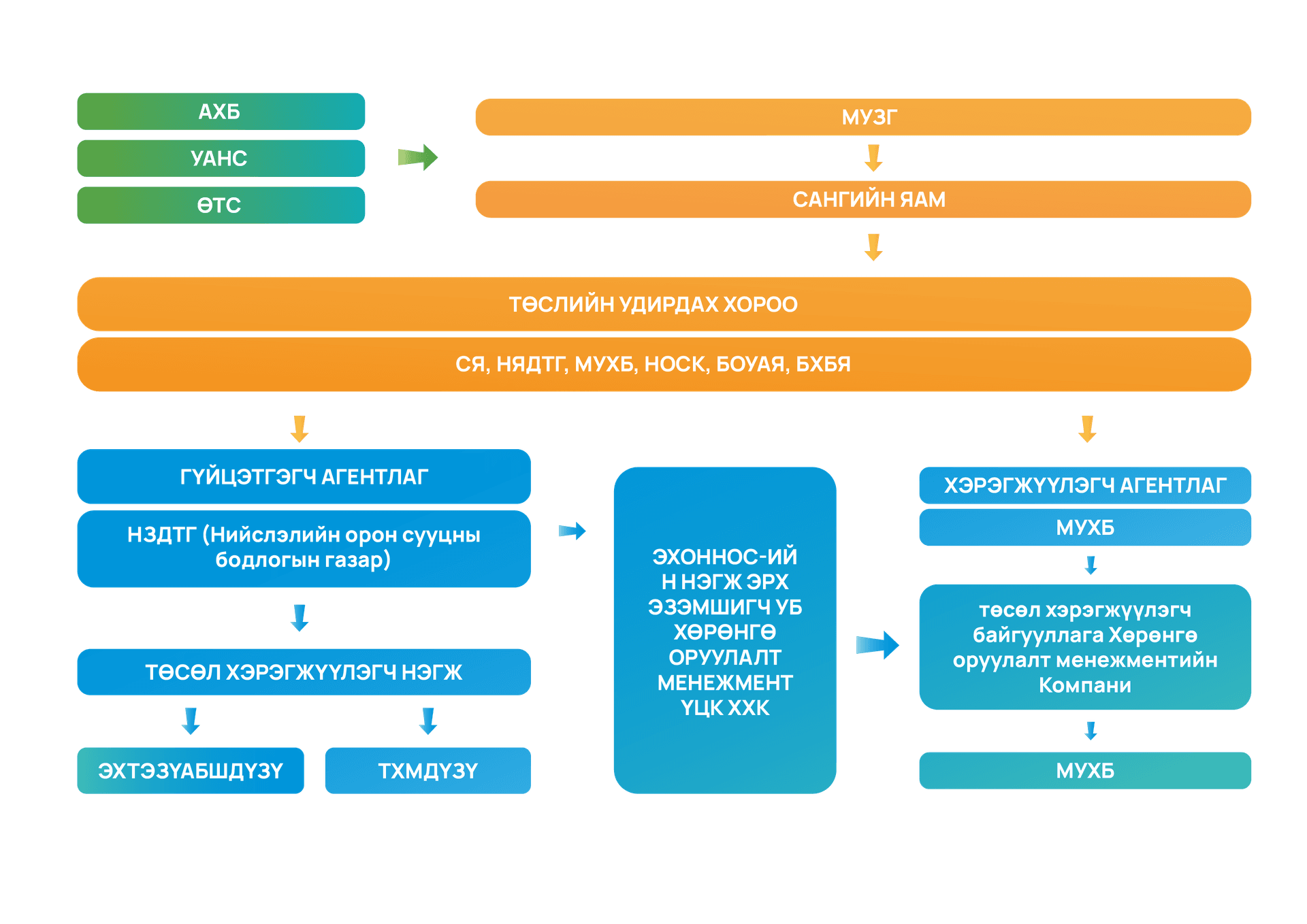
City Governor’s Office of Ulaanbaatar and the Project Implementation Unit under the Housing Agency
Development partners: Asian Development Bank, Green Climate Fund, and the High-Tech Fund through loans and grants.
Project duration
Project start year:
2019
Project completion year:
2030
The project aims to achieve the following three outcomes:

Outcome 1:
Establish eco-districts with rental and rent-to-own green housing in subcenters.

Outcome 2:
Create a Green Housing Fund, develop loan products for constructing green housing eco-districts in subcenters, and provide green mortgage financing to buyers.

Outcome 3:
Implement policy reforms in green building and green finance.
Phase 1 of the project (2023–2027)
In the first phase of the project, 800 green housing units are being built in the Bayankhoshuu and Sharkhad subcenters, with the first blocks of 220 housing units scheduled for commissioning in Q4 2025.
The construction of the remaining 580 green housing units with eco-districts is planned to be completed in 2026.

Phase 2 of the project (2024–2030)
In the second phase of the project, 4,200 green housing units with eco-districts will be built from 2024 to 2030 with investment from the Green Climate Fund.
This component will be implemented with joint financing by the Eco-District and Affordable Housing Fund (EDAF) and the private sectors. Established in June 2025, this fund will provide business green loans to participating construction companies through commercial banks that meet project requirements, as well as mortgage loans for citizens purchasing housing.

Household chimneys will be reduced

Pit latrines will be reduced

kWh of energy will be saved

liters of water will be saved

kWh of heat will be saved.

tons of greenhouse gas emissions will be reduced.